Geological Society
of Minnesota
Geological Society
of Minnesota



Monday, November 16, 2026 from to
Seminar Lab Date: November 4, 2026
Seminar Lab Subject: The Hope Diamond and Other Stories from the Smithsonian Gem & Mineral Collection
Seminar Lab Presenter: Jeffrey Post, Ph.D., Curator of Gems & Minerals (emeritus), Smithsonian National Museum of Natural History
Seminar Lab Location:
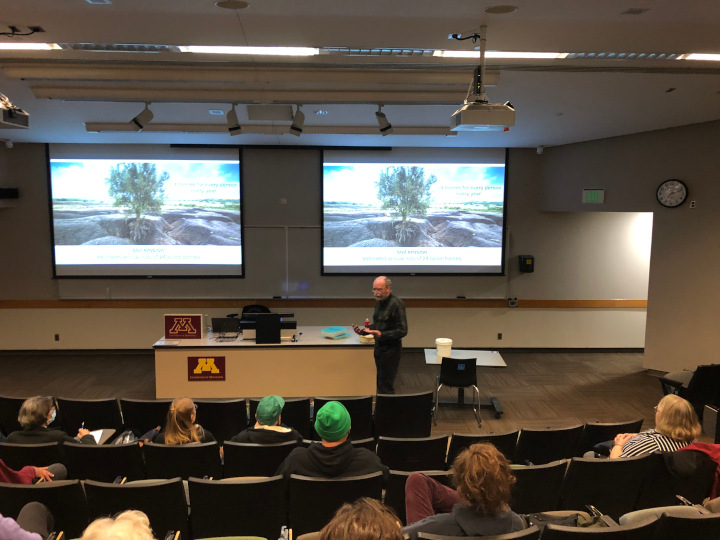
In-person only at University of Minnesota, Tate Hall, Room B20
Time: 6:00 PM CT (note earlier time)
Seminar Lab Detail:
Summary: The Hope Diamond is one of the most famous gemstones in the world. It is familiar to most people because of its fascinating human history that includes kings and thieves and perhaps a curse or two, but it is also a rare blue diamond, the largest and finest of its kind known. Despite its long history in the public eye, the diamond still prompts many questions. The United States National Gem Collection at the Smithsonian Institution is also well-known for its many other world-class gems and jewelry pieces. Curator-emeritus, Jeffrey Post, will explore the science and lore behind some of the famous and lesser-known gems in the National Collection.
Biography: Dr. Jeffrey E. Post received Bachelor of Science degrees in geology and chemistry from the University of Wisconsin – Platteville, and his Ph.D. in geochemistry from Arizona State University. Prior to joining the Department of Mineral Sciences at the Smithsonian Institution’s Museum of Natural History in 1984, he was a Postdoctoral Research Fellow at Harvard University. He was Chairman of the Department of Mineral Sciences 1989-1994 and 2014-2019, and from 1991 to 2023 served as Curator-in-Charge of the National Gem and Mineral Collection. Dr. Post was the lead Curator for the Janet Annenberg Hooker Hall of Geology, Gems and Minerals that opened in 1997. In May 2023 he was appointed research curator, emeritus. He is on the Board of Governors for the Gemological Institute of America.
He has published more than 150 scientific articles and is author of The National Gem Collection, and the recently published: The Smithsonian National Gem Collection—Unearthed: Surprising Stories Behind the Jewels.
Seminar Lab Date: November 9, 2026
Seminar Lab Subject: New Mapping of the Baraboo Hills Unravels a More Complex Geologic History for Southern Wisconsin (V)
Seminar Lab Presenter: Esther Stewart, Ph.D., Senior Geologist, WI Geological & Natural History Survey
Seminar Lab Location:
**Virtual Online Lecture**
Participation instructions will be e-mailed to GSM members. If you are not a member of GSM and wish to attend this free seminar online, register as follows by 8 AM CT Monday, Nov 9: Go to the Contact menu above and select “Ask GSM”. In the form that appears, enter your name and e-mail address. Enter “Nov 9 lecture” in the subject line. In the message body, please enter the city and state or country from which you will view the seminar. You will receive instructions by e-mail prior to the lecture. Check your spam folder if the instructions do not appear in your in-box at least one hour prior to the lecture.
Seminar Lab Detail:
Summary: The Baraboo Hills of southern Wisconsin preserve over a billion years of earth history spanning growth of the ancient North American continent, flooding by tropical seas, and more recent glaciation. New geologic mapping of the Baraboo Hills adds detail to the oldest, Precambrian rock units and advances our understanding of how these rocks formed. In this talk I’ll present an overview of the new geologic map and how it contributes to our understanding of Wisconsin geology.
Biography: Esther Stewart has been a geologist with the WGNHS since 2013. Prior to joining WGNHS she worked for ExxonMobil in Houston, TX for several years. She earned her masters in geology from Idaho State University and recently completed her PhD at UW-Madison. Her research interests involve using geologic maps and stratigraphic frameworks to address practical issues in Wisconsin.
Seminar Lab Date: November 23, 2026
Seminar Lab Subject: Mars Demystified: What Everyone Should Know
Seminar Lab Presenter: Protiti Roy, Ph.D. Candidate, Graduate Fellow, University of Iowa
Seminar Lab Location:
In-person only at University of Minnesota, Tate Hall, Room B20
Lecture start time 7:00 PM CT
Seminar Lab Detail:
Summary & biography TBA
TBA
Board Meeting Agenda